Open More Possibilities. Join a community of donors shaping the future of Jewish life.

From Intention to Action: What JDAIM Is Teaching Our Community About Inclusion
From Intention to Action: What JDAIM Is Teaching Our Community About Inclusion

Jewish Disability Awareness, Acceptance, and Inclusion Month (JDAIM) invites us each year to ask a hard but necessary question: who feels fully welcomed into Jewish communal life and who still encounters barriers, even when our intentions are good?

When values outpace systems

In recent years, our community has begun to confront an uncomfortable truth., While many Jewish organizations deeply value inclusion, good intentions alone are not enough to create access, especially for young adults with disabilities. Inclusion requires skills, systems, and sustained commitment.

Learning what inclusion requires

That realization came into focus in 2023, when we partnered with Matan, a national leader in disability inclusion in Jewish life, to conduct a communitywide assessment. Matan works with Jewish organizations across North America to build the tools and confidence needed to create truly inclusive communities. One finding stood out clearly: Jewish professionals wanted to be inclusive of people with disabilities, particularly young adults, but many did not know how to translate that desire into practice.

That insight became a turning point.

Turning learning into action

In response, we launched the Lieberman Fellowship for Jewish Organizations Serving Young Adults, a yearlong cohort learning experience (2024–2025) led by Matan. The fellowship focused on moving organizations from intention to implementation, helping teams rethink policies, practices, and culture through an inclusion lens. At the conclusion of the learning year, participating organizations, along with one additional congregation, received grants to turn learning into action through concrete inclusion projects.

This JDAIM, we pause to take stock of progress at the projects’ midpoint. What we found was encouraging—not because the work was finished, but because it is becoming more thoughtful, more systematic, and more honest.

What’s changing across our community

Across the region, organizations are shifting away from ad hoc accommodations toward intentional, systems-based approaches to access. Some are redesigning how people request accommodations or improving digital and physical accessibility. Others are investing in staff training, inclusive employment pathways, peer support, or relationship-centered spaces like Shabbat tables and social programming. Again and again, we are seeing that small but deliberate changes—clear communication, accessible tools, sensory supports—can dramatically expand participation and belonging.

That progress has not come without challenges. Many teams underestimated how long it would take to coordinate across departments and partners. Staff transitions and technology limitations slowed timelines. In some cases, organizations intentionally slowed decision-making to ensure solutions would be sustainable and meaningful rather than rushed. These challenges are real, but they also reflect a growing sophistication in how our community understands inclusion: not as a quick fix, but as long-term work that must be built to last.

Inclusion, in action

Each organization is approaching inclusion differently, shaped by its mission, audience, and capacity. Together, these efforts reflect a shared shift toward more intentional and sustainable access.

Inclusive employment and workforce pathways

  • Adas Israel is piloting a supported employment program for young adults with intellectual and developmental disabilities, envisioning a multi-year pathway to meaningful, paid work and vocational growth.

Accessible spaces, programs, and experiences

  • Bender JCC is investing in accessible fitness equipment and assistive listening devices, alongside hosting sensory-friendly cultural programming.
  • Edlavitch DCJCC repaired hazardous entryways and launched a visibility campaign highlighting accessibility across programs.

Digital communications access

  • GatherDC transformed its community calendar to include accessibility information, mobile usability, and screen-reader tools, changing how thousands of young adults find Jewish experiences.

Peer support, community design, and belonging

  • B’nai Israel Congregation is pairing a young adult inclusion peer program with accessible communication training for staff and lay leaders.
  • OneTable supported hosts creating intentionally inclusive Shabbat tables, including spaces centered for autistic and Deaf/ASL communities.

Data-informed systems and long-term engagement

  • Pozez JCC is building data-informed systems to track and strengthen engagement of neurodiverse young adults over time.

Training, capacity-building, and organizational practice

  • Mem Global distributed social inclusion kits, launched accessibility microgrants, and is preparing to hire a Camper Care Director to support emotional and behavioral needs at immersive experiences.
  • Sixth & I is preparing comprehensive social inclusion trainings for staff and volunteers serving young adults in less-structured Jewish spaces.
  • Temple Rodef Shalom standardized its accommodation request process, shifting from informal responses to clear, transparent, and equitable access systems.

The lesson we’re carrying forward

Perhaps the most important lesson emerging from this work: inclusion is grounded in relationships, strengthened through training, and sustained by systems, not by individuals alone. When access is embedded into how organizations operate, it becomes part of communal life.

Beyond JDAIM

This JDAIM, we are not just raising awareness. We are witnessing growth—imperfect, iterative, and deeply committed. Our community is learning what it truly means to create Jewish spaces where young adults with disabilities are not merely accommodated, but genuinely welcomed, supported, and able to belong.
Learn more

Related posts

A Reminder We All Share: Community Safety Is a Shared Responsibility

A Reminder We All Share: Community Safety Is a Shared Responsibility

Keeping our community safe is something we do together.

Recently, a security concern was identified and reported quickly thanks to the awareness and vigilance of a few community members. Because they trusted their instincts and spoke up, the situation was addressed promptly and did not escalate.

While the incident itself was resolved, it offers an important reminder: training matters—and so does taking action when something doesn’t feel right.

Awareness Is a Skill We Can All Build

Every one of us has a role to play in maintaining safe, welcoming environments across our community and within our institutions. Sometimes that role looks like participating in a security training. Other times, it’s simply noticing what’s around you and trusting your intuition.

Small observations can matter more than we realize:

  • An unfamiliar person lingering
  • Clothing or behavior that doesn’t fit the setting
  • A vehicle parked in an unusual way
  • A conversation that feels out of place

Individually, these details may seem minor. Together, they can provide critical information—but only if someone chooses to say something.

As We Look Ahead

As we enter a new year, we know the Jewish community will continue to navigate complex and challenging moments. One of the ways we care for one another is by staying alert, informed, and prepared.

JShield supports this work by offering free security trainings for individuals and institutions across our community. These sessions help build confidence, sharpen awareness, and provide practical tools for navigating uncertain situations.

Just as importantly, we encourage everyone to:

  • Trust yourself when something feels off. Your instincts are often the first line of defense.
  • Speak up promptly. Timely reporting allows for effective response and mitigation, whether that means contacting JShield, your institution’s security team, a staff member, or local authorities.

Looking Out for One Another

Our strength as a community has always come from the way we look out for one another. This moment reinforces a simple but powerful truth: safety is a shared responsibility—a team effort. When we act together, we are more resilient.

Thank you for your continued partnership, your vigilance, and your commitment to keeping our community safe and welcoming.

Support community security

Related posts

Understanding Our Community to Strengthen Our Future

Understanding Our Community to Strengthen Our Future

What we’re learning from the 2025 Impact Index Pulse Survey 

This summer, more than 1,300 Jewish community members from across Greater Washington participated in Federation’s Impact Index Pulse Survey, giving us a clearer picture of how Jewish life is experienced across our region. Through a 20-minute text-based survey, respondents shared their attitudes and behaviors across eight pillars of communal wellbeing: engagement, education, belonging, safety, activism, health, caring, and connection to Israel and global Jewry.

Conducting research like this is core to our role in the community. We invest in data projects like this to inform our strategies and investments, and to equip synagogues, schools, human service agencies, and community-building organizations with insights they need to strengthen Jewish life in alignment with their own missions.

While we are not a synagogue, this insight matters deeply for synagogue leaders to know that among 29% of individuals who are not currently engaged but want to be, affordability is real barrier. 78% of those individuals say they would participate more in synagogue life if membership were more affordable.

This finding is especially important for our human service agencies: only 44% of individuals who identified as financially vulnerable reported knowing where to find help in the Jewish community during a time of need—in comparison to 55% of more well-off individuals.

We do not exist in a vacuum. Our community is telling us clearly where the opportunities lie: deepening engagement, expanding belonging, strengthening care, and ensure that every Jew regardless of geography, background, or perspective has access to a vibrant Jewish life. The survey shows that 72% of Jewish adults in Greater Washington consider themselves engaged with Jewish life to some degree, and at the same time, 54% say they would like to be more engaged, including 62% of respondents under the age 35 who live in the inner core of Northern Virginia and D.C. proper.

Federation will continue to fund and lead studies like this because understanding our community is essential to strengthening it, and to stewarding our collective resources responsibly.

Explore the report

Related posts

Security Isn’t a Reaction—It’s a Relationship

Security Isn’t a Reaction—It’s a Relationship

Sunday’s attack in Australia may have happened halfway around the world, but for many of us, it hit much closer to home.

That’s the nature of Jewish vulnerability today. A violent act against a Jewish community “over there” immediately reverberates here. Our sense of safety shifts. Our plans are second-guessed. Fear creeps in.

And that’s exactly why Federation’s security work through JShield isn’t reactive. It doesn’t ebb and flow with the headlines. And it certainly doesn’t start the night before an event.

Because by the time something happens—whether it’s in Sydney or Silver Spring—it’s already too late to start building the relationships, training, and infrastructure that real security depends on.

What You Didn’t See Yesterday

As soon as we learned of the attack in Australia, our first calls were to local law enforcement partners and the FBI.

We didn’t have to introduce ourselves. We didn’t need to explain why something happening halfway around the world matters here. These are relationships we’ve built steadily over years. When we call, they respond. And they did.

That kind of response isn’t automatic. It’s built on trust. And it’s something we help every institution cultivate—hyper-local connections, district commanders who know your name, first responders who’ve walked your halls. Because when something happens, you don’t want to meet them for the first time. You want to greet them like an old friend.

From Panic to Planning

After the attack, our inboxes filled with last-minute security requests from organizations hosting Chanukah events that had been on the calendar for weeks.

It’s understandable. But it misses the point.

If you needed security last night, you needed it three weeks ago when the event was planned.

Security isn’t something you switch on out of fear. It’s something you build over time—through planning, training, and partnership. That’s what JShield is here to help our community do.

The Power of Community Reporting

Last year, more than 30 Jewish institutions in our region received threatening letters, most vaguely referencing Gaza, some outright menacing. On their own, each one might have been brushed aside.

But thanks to the reporting we encourage through JShield, we saw the bigger picture. We connected the dots across states. We got the FBI involved.

And we got results. The suspect, who lives just outside Silver Spring, recently pled guilty to federal hate crime charges. That outcome didn’t just happen. It was made possible by a community that’s engaged, prepared, and connected.

What Security Really Looks Like

Since JShield launched, we’ve helped bring in more than $5 million in federal security grants for local Jewish institutions. We’ve done hundreds of threat assessments. Helped write emergency protocols. Trained thousands of people on situational awareness and how to stay calm under pressure.

And we know those trainings stick. One teacher told us she starts every school day with a breathing exercise she learned from us. Not because she’s scared, but because it helps her and her students feel grounded.

That’s what we mean when we say training is like putting money in the bank. You don’t get to choose the emergency. But every bit of preparation makes you more ready for whatever comes.

This Moment Is Personal. And It’s Urgent.

If you’ve felt a little more anxious dropping your kids at school or wondered if your synagogue is doing enough to stay safe, you’re not alone. We’re hearing it across the community. And we feel it too.

But fear alone doesn’t keep us safe. Action does.

Right now, we have a critical opportunity. Thanks to a generous match, every dollar you give to support Federation’s security work through JShield will go even farther. That means more trainings, more assessments, and more direct support to institutions across Greater Washington.

Because cost should never be a barrier to security. That’s why every service JShield provides—from threat assessments to training—is offered free to the community, powered by Federation and donors like you.

Security doesn’t start with police. It starts with preparation, with connection, and with showing up for each other before something happens, not just after.

We can’t wait for the next headline to get ready. This is the moment to act.

Give now to protect Jewish life in Greater Washington. Let’s meet this moment—and this powerful matching opportunity—together.

Support community security

Related posts

What 45 Seconds Taught These NoVA Leaders About Belonging

What 45 Seconds Taught These NoVA Leaders About Belonging

Inside the opening night of Federation’s second Northern Virginia Leadership Cohort

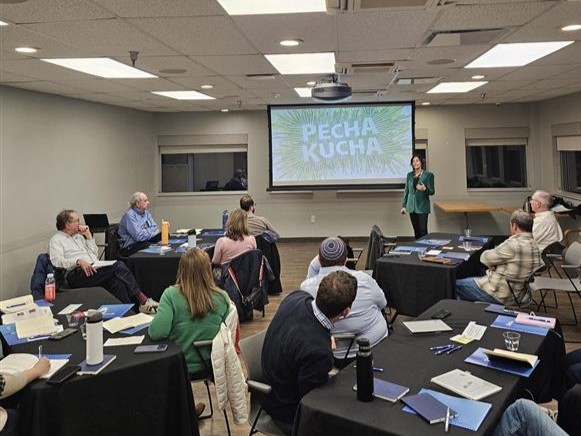
When Jen Kulkin stood up to speak, she had just 45 seconds. No slides, no long bio—just one image and a powerful prompt: Describe a time you felt a part of a community.

Her answer? A deeply personal story, told through a single photo. It was part of a rapid-fire activity called Pecha Kucha (Japanese for “chit chat”) that marked the opening night of Federation’s second Northern Virginia Leadership Cohort, held earlier this month at the Pozez JCC. One by one, each of the 17 new cohort members took their turn—revealing, in just under a minute, a glimpse into what “community” means to them.

Everyone’s story about community was different, yet the idea was the same: a place to belong, feel safe, and bond over shared experiences. That’s exactly what we’re aiming to create, and support, in Northern Virginia.

And that’s exactly the point.

Not Your Average Leadership Program

Over the next few months, these leaders—representing Pozez JCC, JSSA, Temple Rodef Shalom, Rodef 2100, George Mason Hillel, Beth El Hebrew Congregation, Federation’s Network NoVA Alliance, Gesher, Agudas Achim, Olam Tikvah, AIPAC, Congregation Beth Emeth, and Capital Camps—will gather for four sessions led by master facilitator Rae Ringel. They’ll explore the real drivers of leadership: how to listen, build trust, inspire action, and approach communal challenges with creativity and collaboration.

But before any of that, they’ll get to know each other. Not through titles or résumés, but through lived experience and through moments like PechaKucha, where vulnerability becomes the starting point for connection.

Championing Northern Virginia

Federation launched the Northern Virginia Leadership Cohort as part of our bold vision to ensure NoVA continues to grow as a vibrant hub of Jewish life—where leaders, donors, and community members feel connected, supported, and seen.

This cohort is a key investment in that future. By convening diverse leaders across institutions, we’re strengthening the web of relationships in Northern Virginia that makes Jewish community resilient and helping build the kind of trust and collaboration that can only be nurtured.

Because leadership isn’t just about strategy. It’s about showing up, listening deeply, and building something bigger together.

Learn more

Related posts

What This Moment Means and How We’re Responding

What This Moment Means and How We’re Responding

In the wake of the horrific terrorist attack in Australia, I want to speak directly to our community here at home.

Our hearts are with the victims, their families, and the Jewish community in Australia as they mourn and begin to heal. Violence against Jews anywhere reverberates everywhere, and moments like this understandably heighten concern within our own community.

Here in Greater Washington, the safety and security of Jewish life remains our highest priority. Through JShield, Federation’s community-wide security initiative, we are in close coordination with local and federal partners and with Jewish ​institutions across our region, supporting schools, synagogues, and organizations with threat monitoring, training, assessments, and grant support at no cost. You can learn more about how JShield works to keep our community safe at shalomdc.org/security.

If you see or experience something concerning, we encourage you to report it to JShield. Reporting helps identify patterns and supports coordination with our security partners.

Jewish life will continue. We will gather, celebrate, learn, and mark our holidays together, thoughtfully, responsibly, and with care for one another.

At the same time, this moment calls on all of us to be attentive to the language and actions we tolerate in our public spaces. Antisemitism, in any form, must be named and challenged, and Jewish communities must never be left to carry that burden alone.

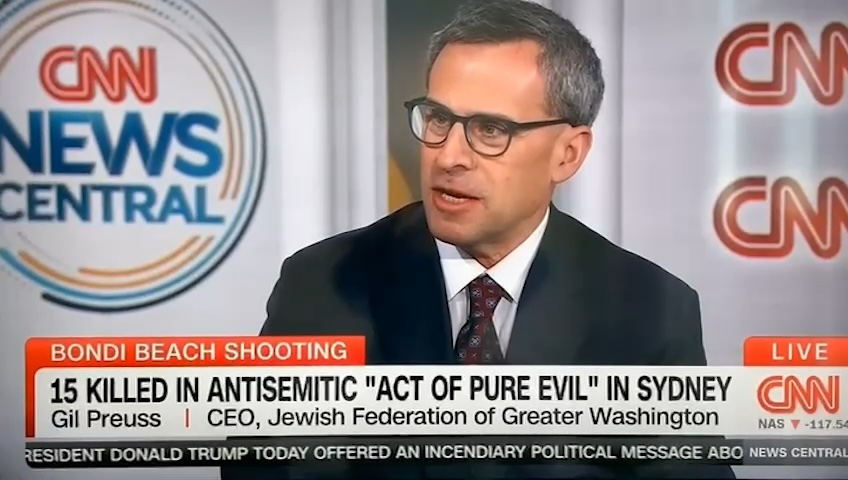
Earlier today, I shared these concerns in a brief conversation on CNN about antisemitism and the responsibility to challenge it before it escalates. You can watch it clip below.

Thank you for the many ways you show up for one another and for our community, especially in difficult moments. We are grateful for your partnership and your trust, and we remain committed to keeping Jewish life in Greater Washington strong, safe, and connected.

This is a moment for shared responsibility. Take action by supporting JShield and strengthening Jewish community security.

Support community security

Related posts

Lighting the Way, Together

Lighting the Way, Together

My family and I purchased an electric menorah to use this Chanukah. We’ll be employing our beloved wax-adorned menorahs too, of course, but this way we can place the electric one in the window without setting the curtains on fire. I already feel good about it. Instead of worrying about what hazards might befall us, we can display our menorah with pride the way Chanukah tradition encourages us to do.

Even if you choose not to display your menorah publicly, the holiday offers a timely opportunity to reconnect with what it means to take up space in this world and use our agency for good. At a time when we are having to defend our place in society, Chanukah offers us the chance to stand proudly as Jews as we work to illuminate a brighter future for ourselves and all communities—skills we are going to need in the year ahead.

Our hypothesis at Federation is this: the more we can help individuals connect with their Jewish identities, be part of strengthening their communities, and come together to address crucial needs, the better off those individuals, the Jewish people, and the world will be. In growing Jewish life, we sustain ourselves and the world around us.

We therefore strive to take the messy, ambiguous work of community building and infuse it with strategy, resources, and meaningful connections. You could think of us as a communal windowpane, helping to refract light inward, outward, and onward.

With all this in mind, I want to invite you to make the most of this Chanukah and give to Federation. We have just a few weeks left in our Annual Campaign, and we need as much metaphorical light and literal funds as we can get. It’s clear 2026 will be a consequential year for the American Jewish community and we want to be ready.

For all the challenges, I feel incredibly privileged to help shape and shepherd Jewish life through this chapter. I know many of you feel the same. I remain eternally grateful for your partnership and wish you joy, warmth, and an abundance of inspiration this Chanukah season.

Related posts

Making Jewish Camp Magic, Thanks to One Happy Camper Grants

Making Jewish Camp Magic, Thanks to One Happy Camper Grants

There’s a kind of magic that only happens at Jewish summer camp and stays with kids long after summer.

Families tell us stories of a sunrise tefillah (prayer) that sparks growth, new friendships that feel like home, and a sense of belonging that can’t be taught. And for many, financial support like our One Happy Camper grant is what makes that magic possible.

“One word: HUGE.”

For this two-parent working household, balancing synagogue dues, religious school fees, and the rising costs of Jewish life made camp feel daunting. The help they received made a real difference.

It also made an impression: when their ninth grader recorded a school video about an inspirational moment, they chose sunrise tefillah (prayer) at camp.

“I can teach them all the Torah I want,” the parent said. “But it is camp that inspires my kids.” “If we hadn’t received support, I don’t know if he could have gone.”

“If we hadn’t received support, I don’t know if he could have gone.”

That’s what one parent told us after being unexpectedly fired from their job without severance—a shock that left them searching for employment for months.

In that moment, camp felt completely out of reach.

But with support from Federation, camp, and their synagogue, their son spent a month at Ramah Poconos—a month they described as “pivotal.” He came home more connected to his Jewish identity, more grounded, and surrounded by deep friendships that carried him through a hard year.

The parent is still unemployed and already worried about next summer. But their gratitude is unmistakable: “I am so grateful for the generosity of the Jewish community, and will likely have to count on more support next year.”

“Financial aid is truly transformative.”

For another family, camp would have remained just a dream without support.

For their daughter, a summer at Capital Camps meant:

  • her first taste of independence outside of home
  • lifelong friendships
  • belonging in a Jewish community
  • emotional and spiritual growth
  • discovering her strengths

As her parent put it: “Financial aid isn’t just a subsidy. It’s an investment in children, families, and the future of the Jewish community.”

“Camp would have been the first thing we had to cut.”

Another family shared that when the husband lost his job due to federal cuts, camp became the first thing they thought they’d have to remove from the budget.

But because of the grant they received, their children still experienced everything camp offers—confidence, leadership skills, connection, and identity-building.

“The support made it possible for our children to find a home within the Jewish community where they feel strongly connected and wish to give back.”

Making Jewish Camp Possible for Every Family

Jewish summer camp gives kids joy, independence, community, and identity.

It’s where friendships form in bunk beds, where confidence grows by the lake, and where Judaism becomes something kids feel proud of, not just something they learn.

And for so many families in our region, financial support is what makes that possible.

Make the magic of Jewish camp possible—whether for your family or another.

Apply for a One Happy Camper grant for up to $1,500 through December 31.

And if you’re in a position to give, your support can help another family send their child to camp. Donate today

One Happy Camper (OHC) is a need-blind first-time incentive grant sponsored by a partnership between Federation and Foundation for Jewish Camp. Federation supports over 220 first time campers attending 30+ camps across the country each year through OHC. Federation has distributed first-time incentive grants through One Happy Camper for over 15 years.

Since 2020, Federation also significantly allocates funds annually to 20+ camps for need-based financial aid scholarships for campers from Greater Washington.

Photo: Capital Camps & Retreat Center

Learn more

Related posts

Your Dollars at Work: Shaping the Next Generation of Jewish Leaders

Your Dollars at Work: Shaping the Next Generation of Jewish Leaders

Investing in the next generation of Jewish leadership in DC

On their first Shabbat in DC earlier this fall, 13 young adults gathered in Rock Creek Park not just to meet each other, but to ground themselves in purpose. Under the trees, they sang Hashkiveinu together in a ritual led by Rabbi Gita Karasov, an alumna who once stood where they now sit.

That moment marked the start of a year that will challenge, stretch, and shape them as individuals and as leaders.

These 2025–26 Corps Members are part of Avodah, a Federation partner that places young Jewish changemakers in a year of immersive service. They live together in the DC bayit (house), explore Jewish pluralism in daily life, and serve at local nonprofits including Bread for the City, Jews United for Justice, and Higher Achievement.

Their orientation alone included a walking tour of U Street to learn about the legacy of Black Broadway and a deep dive into disability justice with Rabbi Lauren Tuchman. More than just training, it was a week of becoming rooted into community, justice, and Jewish values.

We believe Jewish leadership must reflect the urgency, diversity, and moral clarity this moment demands. Through your support, we’re helping these young adults lead with purpose, live their values, and build something bigger than themselves—right here in Greater Washington.

This is what happens when generosity meets action. Together, we’re shaping a Jewish future built on justice, belonging, and bold leadership.

Related posts

Listening With Open Curiosity

Listening With Open Curiosity

What the Community Leadership Council Is Building Next

In a time when conversations often feel like battlegrounds, The Jewish Federation of Greater Washington is charting a different course: creating space for humility, respect, and the quiet power of listening.

The Community Leadership Council (CLC)—a group of 100+ community builders from across Greater Washington—is at the heart of that shift. And now they’re launching a bold Listening Campaign. The goal? Not to agree on everything. But to understand each other more fully and build real trust, even when we don’t land in the same place.

Who’s in the room

The CLC isn’t just another leadership committee. It’s part of a new model for how Jewish Greater Washington shows up, listens in, and makes decisions together.

Its members span more than 100 organizations: synagogues, schools, service agencies, and grassroots groups. They come from different generations, professions, political beliefs, and religious identities. Some are longtime Federation partners, others are new to this work.

They were brought together to reflect a broader range of voices. And now, they’re listening—with purpose and intention—not just as individuals, but as a new kind of leadership collective committed to understanding and learning together.

By design, CLC members wear two hats: the “community member” hat, representing their own lived experiences, and the “community leader” hat, bringing in and analyzing the voices of an even wider circle. The goal? To surface critical issues and insights that Federation and other organizations can address in the years ahead.

Listening is harder than it sounds

Most of us think we’re pretty good listeners. We nod, we wait our turn, we make eye contact. But real listening—the kind that helps people feel heard and seen—is a lot trickier than it looks.

And when the topic touches on deeply held values—identity, politics, Israel—it’s even harder to stay open. But that’s exactly when it matters most.

That kind of listening takes more than good intentions. It’s a skill, one that can be practiced, honed, and strengthened over time.

Practicing the hard stuff

That’s what CLC members set out to do this fall by joining workshops with two organizations that specialize in the art of tough conversations: Resetting the Table and For the Sake of Argument.

These weren’t lectures—they were labs.

  • Resetting the Table’s Speaking Across Conflict training focused on real tools for navigating charged conversations, especially around Israel and the current political climate in the U.S.
  • For the Sake of Argument used a curriculum built on stories designed to provoke disagreement—on issues central to Israel and Jewish life—then helped participants stay curious, reflective, and in relationship.

For many, the most eye-opening lesson wasn’t just how to listen. It was realizing how much difference exists even among people who think they’re aligned.

When it gets real

“One of the most surprising takeaways was how much difference there is even among people who think they’re on the same page,” said one participant. “It reminded me how important it is to keep asking, not assuming.”

Another brought the experience home. At a recent Shabbat dinner, when the conversation got tense, she didn’t change the subject or shut it down. She stayed curious. She listened. And the conversation stayed open.

As Lisa Silver-Kopit put it: “In such a charged moment, it’s a relief to have tools that help us talk and listen with respect. These skills don’t make disagreement go away, but they make it possible to stay in relationship even when we see things differently.”

What’s next and how you can be part of it

Between now and the end of February, the CLC is hosting listening gatherings across Greater Washington.

These aren’t forums or focus groups. They’re small, meaningful conversations about what matters to you. What’s working. What’s missing. What makes you feel connected—or left out. What kind of Jewish community you want to build next.

And the insights shared won’t disappear into a spreadsheet. They’ll directly inform how Federation—and our entire ecosystem of Jewish life—moves forward.

Want in? Interested in joining a listening group or bringing a few people together to host your own? Let us know!

We’re building something new together. A more open, connected, and resilient Jewish Greater Washington. That can’t happen from the top down or from behind a podium.

It starts with listening. And it starts with you.

As Marla Schulman, Chair of the 2025-2026 Inaugural Community Leadership Council put it:

“This campaign is about discovering the community we all want to build together. When we really listen to each other, we learn that we don’t have to agree on everything to care about each other. And we find the common ground to move us forward. That’s where real connection begins.”

Related posts