More Than a Mission: Greater Washington’s Growing Bond with Kibbutz Nir Oz
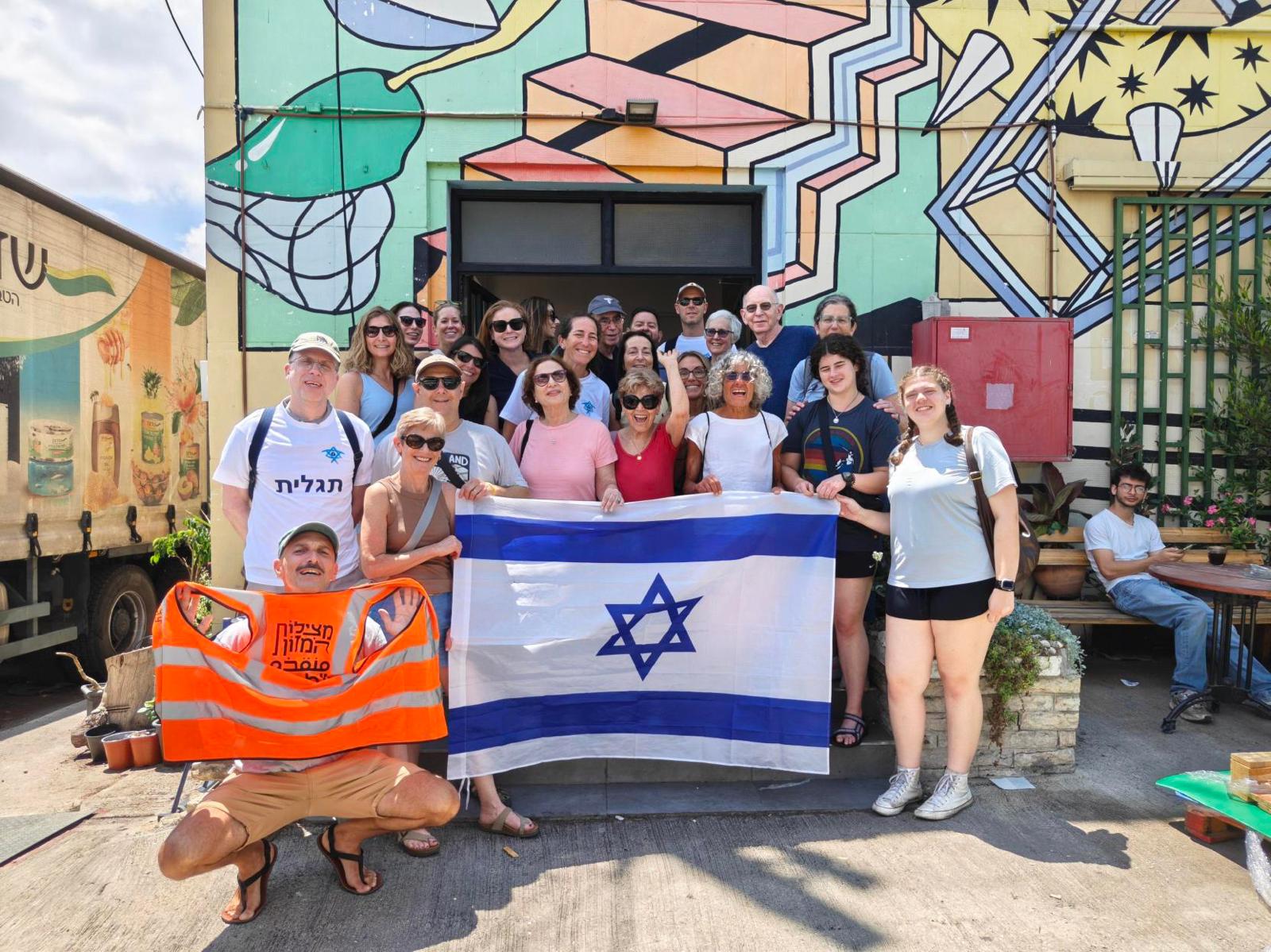
This past July, the swimming pool at Kibbutz Nir Oz was open. For a little while, volunteers from Greater Washington swam, talked, and laughed.
Then they dried off and walked toward what remained of the homes destroyed on October 7.
The contrast was jarring. So was the message. Nir Oz is not simply a place where something terrible happened. It’s a community working, piece by piece, to thrive again.
For more than 25 members of Greater Washington’s Jewish community, that contrast became one of the defining moments of an eight-day volunteer mission to Israel this summer. They came to contribute where they could, meet Israelis, show solidarity, and deepen a connection to Nir Oz that already felt personal.
A Relationship Born After October 7
In the days after the October 7 attacks, Salo Zelermyer and Amit Natanzon found themselves thinking about Nir Oz for a deeply personal reason. Their close friend and Hebrew University classmate, Abbey Greenberg Onn, had two relatives murdered there on that horrible day. Three others were taken hostage and held captive in Gaza. Like so many American Jews in those first weeks, they felt an urgent need to do something.
But they began to realize that a donation, even a significant one, couldn’t fully address what Nir Oz was facing.
“We recognized the scale of devastation and trauma experienced by communities like Nir Oz would necessitate support and connection beyond just financial contributions,” Salo said.
So they began building something different. Members of Beth El, Ohr Kodesh, and B’nai Israel congregations came together with Nir Oz to create Kesher Nir Oz, a partnership designed to last beyond the immediate aftermath of October 7.
The idea was simple but ambitious: make Nir Oz’s recovery personal to the Greater Washington community for years to come. That meant more than sending support. It meant visiting, listening, building friendships, finding ways to be useful, and staying connected as the community rebuilds. The Jewish Federation of Greater Washington joined the effort, helping sustain and amplify the partnership.
This summer, together with Federation, American Friends of Nir Oz, Taglit-Birthright Israel, and Israel Outdoors, more than 25 members of the Greater Washington community traveled to Israel to deepen these connections even further.
 More Than Tourists
 More Than Tourists
“This mission was the first program we’ve implemented as part of our new Local Israel Engagement strategy,” said Udi Eitan, Federation’s Director of Integrated Israel Strategy. “A central focus of that strategy is building meaningful, personal connections between Israelis and members of our local Jewish community.”
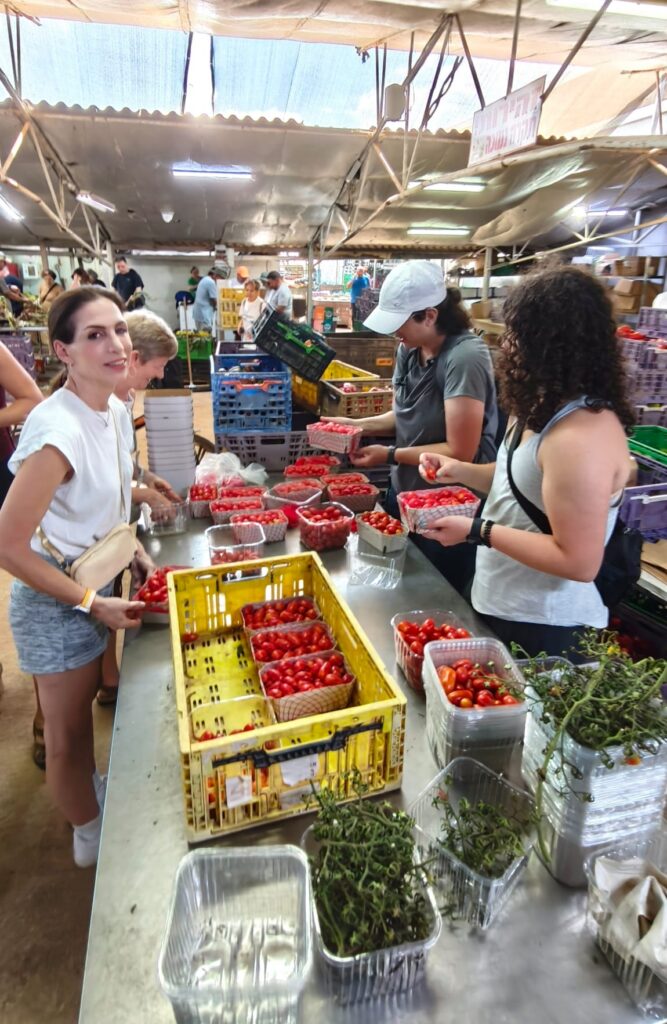
The itinerary reflected that philosophy, with hands-on volunteer work, visits with Federation partners at Kibbutz Re’im and Nir Oz, and encounters designed to expose participants to the complexity and diversity of Israeli society.
For participant Yaffa Rubenstein, the experience held two emotions at once. “One eye is crying over the devastation and the horror of October 7, while the other is filled with joy at the heartwarming sight of people’s deep desire to keep living and supporting one another.”
That contradiction followed the group throughout the trip. They saw places where the wounds of October 7 were unmistakable, and places where people were living life, going to work, filling cafés, shopping in markets, raising children, and rebuilding communities.
At Nir Oz, they saw both: the life that was lost and the life being rebuilt.
The Life That Was Lost. And the Life Being Rebuilt
Todd Miller remembers the visit to Nir Oz as one of the most meaningful parts of the mission. “It was very moving to have the opportunity to talk to members and heartbreaking to tour remnants of homes destroyed on October 7,” he said. “Nir Oz is slowly rebuilding the life that was so vibrant on the kibbutz.”
“He was so inspiring and full of life,” Todd said. “Meeting Gadi and other members who are so dedicated inspired all of us to contribute to the effort.”
A Garden in Haifa
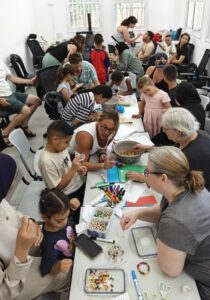
In an Arab-Israeli neighborhood in Haifa, participants spent more than two hours volunteering at a community center, cleaning up landscaping and planting. Then they spent time with local children, roughly ages 8 to 13, playing games, making art, and sharing snacks.
Most of the children didn’t speak English. Instead, they spoke primarily Arabic and Hebrew, but it didn’t matter. “The language barrier didn’t get in the way of our interaction,” Todd shared. For him, it was a small but meaningful glimpse into a part of Israeli life he might otherwise never have encountered.
The trip also widened the lens beyond Nir Oz. In the north, the group visited a Druze village. In Tel Aviv, they walked through Carmel Market. Across the country, they sat in cafés and watched restaurants filled with Israelis going about their lives.
Some of the trip was difficult to absorb. Visits to kibbutzim (communal villages) in the Gaza border region and the Nova site (where 378 Israelis were killed at a local music festival) brought participants face-to-face with the scale of what happened.
And then there were ordinary moments. Todd remembers seeing Israelis “embracing their lives despite the many difficulties of daily life.” That, too, was part of the education.
The Point Was Never Just the Trip
For Federation, the mission extended work that had already been taking root in Greater Washington. As Udi explained: “Having dozens of community members volunteer across Israel, spend meaningful time with members of Kibbutz Nir Oz as part of a growing relationship between our communities, and then bring those experiences back and share them with others in Greater Washington―that’s exactly what we had in mind when we started this journey.”
The mission simply gave those connections a place to grow. For Salo, that is the part that matters most.
“The relationships people in our community have formed with the Nir Oz community are by far our proudest achievement,” he said.
Recovery from what happened in Nir Oz will take years. The needs will change. The ways people can help will change. But the relationship can remain. “We cannot lose sight of the passion and the connection we all felt in the months that followed,” Salo said. “That is what Kesher Nir Oz is all about.”
 Bringing Israel Back Home
 Bringing Israel Back Home
There is an easy way to think about a volunteer trip. You go somewhere, help, and come home. This was something else. Participants came home with a deeper understanding of Israel, knowing people in Nir Oz, having worked alongside Israelis, and having seen parts of the country that do not fit neatly into a news story.
Yaffa put it simply. “You can never truly understand, appreciate, or judge Israelis unless you go there, spend some time there, and see it with your own eyes.”
That is the real power of partnership. It is not only what one community can do for another, but what happens when people begin to know one another well enough that the distance between them starts to shrink.
And they intend to keep showing up. “Our hope is that the connection between our community and Kibbutz Nir Oz will continue to grow in the years ahead,” Salo said, “through continued visits from members of our community to Israel, volunteer missions, and in the one-to-one relationships that this program has helped to form.”
Learn more about Federation’s work to build lasting connections between our community and Israel here.