Find Your Balance
Our thoughts are with West Bloomfield’s Temple Israel community after yesterday’s attack. We are breathing a sigh of relief that everyone remained safe, including students and staff at the temple’s preschool. We are immensely grateful to the security guards, police officers, and firefighters who put themselves in harm’s way and responded to the situation swiftly and effectively.
The incident is a sad reminder of how important robust security measures are today. Through JShield, The Jewish Federation of Greater Washington’s community security initiative, we are continuing to work closely with law enforcement and Jewish institutions across our region to keep our community safe.
I noticed recently that AI was incorporated into a software I use to log my expenses…and it was pretty great. The program automatically filled in blanks, predicted categories, and made the whole upload process easier. I also used it to analyze quantitative and qualitative data, and it brought out ideas and themes that I had not noticed before. I can see why these tools are catching on. And yet, the rise of AI is not affecting our strategy here at Federation.
Even at the dawn of this radical new leap, we believe the future is human. In fact, at a time when AI is transforming everything from our emails to our state policies, I can’t help but notice it’s our humanness that’s gaining cachet.
Perhaps that’s why some banks are now advertising “human help” to attract new customers. Why Hermès commissioned hand-drawn graphics for their website. Or why Apple hired artists to create their new logo out of glass and colored lights. There’s something beautiful and inherently valuable about knowing a real person was involved in the work.
Of course, as Jews, we have always been wonderfully human. For sure, we know how to gather and find purpose and meaning with and among each other. We also learn by relishing in each other’s individual and sometimes unpredictable perspectives. Our texts are contradictory, our debates unique and far reaching. Though the bots may soon be able to mimic our thought patterns, it will be our organic curiosity, creativity, and empathy that will keep us whole.
As Robert Putnam writes in Bowling Alone (not the first time I’ve mentioned this work and not the last), “The single most common finding from a half century’s research on the correlates of life satisfaction, not only in the United States but around the world, is that happiness is best predicted by the breadth and depth of one’s social connections.”
We must continue coming together, in-person, to learn, celebrate, discuss, mourn, serve, or simply be. Doing so will have the dual effect of benefiting us individually and strengthening our entire community. It’s also how we grow. Community manages to both support and sustain us while also putting us in contact with the people who can challenge our assumptions and push us beyond our would-be bubbles. Shabbat dinners, text studies, trips, lectures and so on, will be that much more important in an age of online silos.
To that end, I want to hear from you: where and how do you seek human connection? What are the elements in your life keeping you grounded and engaged with others?
I’m all for innovation. The Jewish community must embrace and leverage cutting edge tools to our advantage. But it’s not lost on me that the more advanced our world becomes, the more we hunger for ancient wisdom. What a phenomenal opportunity we have to subvert the forces that automate and isolate and instead foster the connection humanity craves.
I’ve been thinking about Federation’s role in Jewish life. To be fair, I’m pretty much always thinking about this. But I’m looking at the swirl of everything going on in our world, and wondering what is it that we owe our community in this moment?
As the sociologist Robert Bellah might put it (a reference I’m borrowing from a recent meeting of our Governing Board), some communities find strength in internal alignment while others rely on a series of interconnected bridges to stay strong and cohesive. Our community is likely best defined as a combination of the two. We hold a common commitment to a strong and vibrant Jewish community while operating across a breadth of differences. We must therefore continue building durable throughways to ensure we stay connected to Jewish life and each other.
This, of course, includes our work to engage our community with Israel. Core to our strategy is the goal to engage the full range of our community with the full range of Israeli society according to our community members’ own interests. This year, we’ll be continuing to work with Jewish organizations across our community to build out opportunities for more people to learn about and connect with Israel.
Additionally, as I wrote this week in partnership with scholar Ted Sasson, The Jewish Federation of Greater Washington is a Zionist organization. And as such, we have a responsibility to live up to our definition of the term and show people that Zionism is “broad enough to accommodate a community of Jews who hold (or grapple with) attitudes about Israel that span the range from the right to the left.”
After all, the latest JFNA study found that a majority of American Jews are struggling with specific Israeli government policies, even as they continue to believe in a Jewish, democratic homeland and Israel’s right to exist. If we care about a vibrant Jewish community, we cannot ignore this. We owe it to those deeply troubled by Israel’s actions to continue engaging them and creating the conditions for open dialogue and authentic connections with Israel and Israelis.
On a local note, our latest pulse survey found that political and social disagreements are the number one driver of disengagement with Jewish life and community. After issues of safety and antisemitism, Jews in the DC area rank political polarization as one of the most critical issues facing Jewish Greater Washington. More and more, I see a core part of Federation’s role as not only mitigating this crisis but turning our unique communal makeup into a source of strength.
Disagreement need not mean distance. Uncertainty need not mean isolation. What’s going on in the world, and certainly in Israel, is complicated and, for many, deeply personal. What matters is not that we arrive at the same conclusions but that we feel comfortable and, better yet, moved to meet each other on those bridges and find a way forward together.
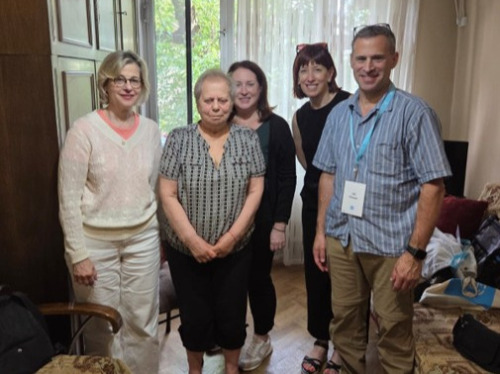
I was in Israel last month on a unique trip. Throughout the time, I heard from Israelis and Palestinians across the political spectrum describe the same feeling: they want a better world for their families and yet feel a profound lack of agency in making it happen. They want progress but don’t feel like there is anything they can do to push back against the overwhelming forces shaping their reality. It struck me that many of us are feeling this way too.
Things feel challenging and worse yet, we feel powerless to change them. We open our news apps and read horror stories. But what are we to do about it? This is a question Jews have grappled with in every age. And the answer remains the same. It’s precisely when things feel the most uncertain and out of our control that we must focus on reclaiming and making use of our own agency.
The role of Federation in this moment is deeply connected to this idea. Part of our mission is to help create the conditions in which individuals and organizations can act with confidence and intention and amplify personal agency to even greater outcomes. How do we keep pushing forward as a community in difficult times? How can we bring people together to amplify impact? These questions are shaping our work today.
Of course, agency is tricky in that it’s layered. First, we must feel we have it. Then we must be motivated to use it. And finally, we must find ways to combine our efforts to create something even more powerful. What’s more, every step is as delicate as it is important. It doesn’t take much to sap our energy. Certainly, the entrenched challenges in the Middle East, the morphing global order, and scenes of violence in our country are enough to render anyone frozen.
I don’t fault anyone for choosing to focus on their immediate zone of responsibility. There is tremendous purpose to be found in looking after our loved ones and doing what we can to make it day to day. But if we are to shape history and build a society that reflects our values, a “beloved community” as Dr. Martin Luther King Jr. put it, then we must find it within ourselves to look beyond ourselves.
We must chip away at the overwhelm. For those who wielded a snow shovel last week will tell you, it’s amazing what you can accomplish with steady determination and the will to break through that which seems immovable. We may not be able to make sweeping policy changes, but we can, at any given moment, make a difference on an individual and even communal scale. We can connect with our neighbors, serve those in need, and work together to strengthen our community.