The Winter Bella Thought She Would Face Alone
In the August heat, winter feels worlds away.
But think back to the coldest day of last winter in Greater Washington: the biting wind, the layers of clothing, the rush to get back indoors. Now imagine facing those temperatures while worrying whether you’d have reliable heat at all.
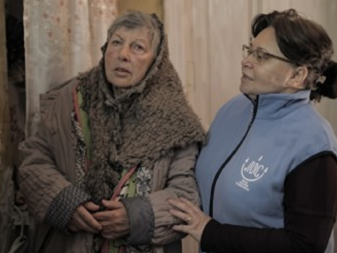
That was the challenge confronting 79-year-old Bella in Odesa, Ukraine, who spent last winter doing everything she could to stay warm.
She turned on her electric heater, but only in the room where she slept. She watched it carefully, knowing every extra minute of warmth came with a cost, as electricity prices have soared since the outbreak of the war in 2022. When the cold became too much, she filled bottles with boiling water and placed them in her bed, letting them provide a little warmth through the night.
But she could not stay in bed all day.
“It gets terribly cold here,” Bella says. “One winter it was only [43 degrees Farenheit]… inside.”
Bella has lived her entire life in the same century-old building, a home that has witnessed decades of history and family memories.
But in recent years, the sounds outside her window have changed.
The war has brought a new reality to Odesa’s elderly Jewish community. Air raid sirens. Attacks on critical infrastructure. Power outages that leave homes dark and cold for hours, sometimes days.
For Bella, who lives alone and depends on a small pension, every disruption creates another worry. Will she be able to afford her medicine? Will she have enough food? Will she be able to stay warm?
But even in the darkness, Bella is reminded of something important. She is not alone.
A Lifeline Across the Ocean
Thousands of miles away, members of The Jewish Federation of Greater Washington community are helping ensure that elderly Jews like Bella are cared for. Thanks to support from Federation’s unrestricted Annual Campaign and grants from its Jewish Community Foundation, the American Joint Distribution Committee (JDC) can provide Bella with essential winter assistance, food, and medication.
Last winter, the help allowed Bella to use her limited income for heating and other necessities, but the impact went far beyond what arrived at her door. It told her that someone remembered her. That someone cared. That she remained part of a Jewish community, even across continents. This month, Odesa has faced waves of horrible attacks. An overnight Russian missile and drone strike earlier this month damaged residential buildings and other infrastructure, leaving people injured and disrupting power and water in parts of the city.
More Than a Number
Bella is one of thousands. In 2025, Federation helped JDC provide lifesaving support to 5,077 elderly Jews throughout the Odesa region, including 847 Holocaust survivors.
Numbers help us understand the scale of a crisis. But they cannot tell us what it feels like to sit alone in a cold apartment, or what it means when someone knocks on your door to help.
Behind every number is a story. There is also Lyudmila, 79, who lives alone and relies on support to afford her medications, food, and utilities. With a monthly pension of only $104, Lyudmila knows exactly how quickly costs can add up.
“I use my JDC bank card to buy my medications,” she says. “Then I can purchase food and pay for utilities from my pension. Without the bank card, I wouldn’t be able to afford the treatment I need to survive.”
Warmth That Goes Beyond the Heater
In Odesa, warmth comes in many forms. Sometimes it is a package delivered to someone’s door. Sometimes it is medicine that makes an impossible choice a little easier.
And sometimes, it is simply a visit.
JDC’s homecare workers provide practical support to frail and homebound seniors, helping with cooking, laundry, errands, and personal care. But their presence offers something equally important: companionship.
A conversation. A familiar face. The reassurance that someone is still looking out for you. This is what Jewish responsibility looks like in action. Kol Yisrael arevim zeh bazeh—all of Israel is responsible for one another.
Keeping Jewish Life Alive
Even after years of crisis, Odesa’s Jewish community continues to find moments of joy. Last year, as Rosh Hashanah approached, seniors gathered with younger generations through Kesher Dorot, a program designed to connect older adults with children and families.
Together, they painted pomegranate paintings by the sea, creating something beautiful while celebrating the traditions that have carried Jewish communities through generations.
For a moment, the war was not the center of the room. Community was.
Because survival is about more than having enough food, medicine, or heat.
It is about knowing you have a family.
They Are Counting on Us
Just this weekend, Odesa faced another wave of horrible attacks. An overnight Russian missile and drone strike damaged residential buildings and other infrastructure, leaving people injured and disrupting power and water in parts of the city.
For people like Bella and Lyudmila, the war is not something they read about in the news. It is the sound of explosions outside their windows. The overwhelming fear that at any minute it may be their home blasted into ruins. It is a dark, freezing apartment when the power goes out, and the rising cost of the food and medicine they need to stay alive.
And it is why our support matters now more than ever.
Through The Jewish Federation of Greater Washington, you can help JDC continue to save lives in Ukraine, providing food, medicine, winter assistance, homecare, and the human connection that reminds people like Bella and Lyudmila that they have not been forgotten.
There are thousands more stories like theirs. And when you give to Federation, you help make sure we can be there for them.