Blacklists through the Ages
I was inspired this week to put together my own Top 10 list as way to look back at 2025 and jump into 2026. I hope you enjoy this snapshot of ideas, content, and ruminations that captured my mind this past year:
Have an answer to any of the above? An offbeat trend prediction of your own? Send them my way, I would love to hear them!
Last week, I wrote about how fed up I felt in the wake of the Bondi attack and how imperative it is that leaders take the threat of antisemitism seriously. My frustration holds as we continue to see leaders dismiss antisemitism as simply “free speech” or as reasonable debate. But today, I want to linger on a more life-affirming note.
I’ve been marveling at all the stories coming out recently about people who, without hesitation, have stood up to help others. The accounts are humbling, inspiring, and serve as testaments to the good inside us. There’s Ahmed el Ahmed who singlehandedly disarmed one of the Bondi shooters and in doing so saved lives, rebuked ISIS ideology, and offered the world a stunning example of heroism. There’s Boris and Sofia Gurman who also confronted one of the Bondi gunmen, giving their lives to save others just weeks before their 35th wedding anniversary. There’s Spencer Yang, a first-year student at Brown who was shot in the leg and still managed to take care of the guy next to him, keeping him conscious until help arrived. And so many more.
I am also, like many of you, thinking about Rob Reiner. My family and I love his movies. Watching The Princess Bride as a family is a core memory for me. Rob’s films always leave me feeling better about people. He had a knack for exploring and celebrating our common instincts and potential for love, including our tendency toward empathy, in ways both subtle and heartwarming. As one commenter wrote on Stephen King’s tribute to the filmmaker, “Rob Reiner’s humanness was turned up to 11.” (If you know, you know…).
This, to me, is the whole game, to find a way to crank up our humanness as high as it will go. In this age of isolation and online rage, there will be no greater power than our ability to tap into our uniquely messy, endearing, creative, loving human traits. There is no foe too great that cannot be bested with our humanity.
In these final days of 2025, I’m holding onto this thought and looking around at all the light piercing through the darkness. We can each of us make a difference in astounding ways (to this end, there’s still time to give to Federation’s Annual Campaign!). I may not have the courage of those heroes at Bondi or the artistic skill of a filmmaker, but I love my community and look forward to serving it alongside all of you in the year ahead. As Rob Reiner might say, storming the castle to build a better future is best done together.
Shabbat Shalom and wishes for a happy, safe, and healthy new year.
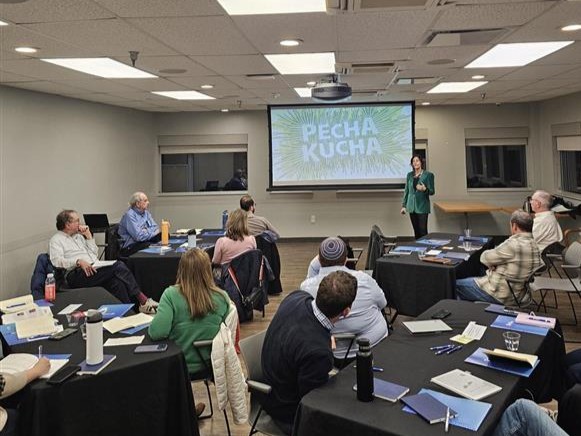
When Jen Kulkin stood up to speak, she had just 45 seconds. No slides, no long bio—just one image and a powerful prompt: Describe a time you felt a part of a community.
Her answer? A deeply personal story, told through a single photo. It was part of a rapid-fire activity called Pecha Kucha (Japanese for “chit chat”) that marked the opening night of Federation’s second Northern Virginia Leadership Cohort, held earlier this month at the Pozez JCC. One by one, each of the 17 new cohort members took their turn—revealing, in just under a minute, a glimpse into what “community” means to them.
Everyone’s story about community was different, yet the idea was the same: a place to belong, feel safe, and bond over shared experiences. That’s exactly what we’re aiming to create, and support, in Northern Virginia.
And that’s exactly the point.
Over the next few months, these leaders—representing Pozez JCC, JSSA, Temple Rodef Shalom, Rodef 2100, George Mason Hillel, Beth El Hebrew Congregation, Federation’s Network NoVA Alliance, Gesher, Agudas Achim, Olam Tikvah, AIPAC, Congregation Beth Emeth, and Capital Camps—will gather for four sessions led by master facilitator Rae Ringel. They’ll explore the real drivers of leadership: how to listen, build trust, inspire action, and approach communal challenges with creativity and collaboration.
But before any of that, they’ll get to know each other. Not through titles or résumés, but through lived experience and through moments like PechaKucha, where vulnerability becomes the starting point for connection.
Federation launched the Northern Virginia Leadership Cohort as part of our bold vision to ensure NoVA continues to grow as a vibrant hub of Jewish life—where leaders, donors, and community members feel connected, supported, and seen.
This cohort is a key investment in that future. By convening diverse leaders across institutions, we’re strengthening the web of relationships in Northern Virginia that makes Jewish community resilient and helping build the kind of trust and collaboration that can only be nurtured.
Because leadership isn’t just about strategy. It’s about showing up, listening deeply, and building something bigger together.
In a time when conversations often feel like battlegrounds, The Jewish Federation of Greater Washington is charting a different course: creating space for humility, respect, and the quiet power of listening.
The Community Leadership Council (CLC)—a group of 100+ community builders from across Greater Washington—is at the heart of that shift. And now they’re launching a bold Listening Campaign. The goal? Not to agree on everything. But to understand each other more fully and build real trust, even when we don’t land in the same place.
The CLC isn’t just another leadership committee. It’s part of a new model for how Jewish Greater Washington shows up, listens in, and makes decisions together.
Its members span more than 100 organizations: synagogues, schools, service agencies, and grassroots groups. They come from different generations, professions, political beliefs, and religious identities. Some are longtime Federation partners, others are new to this work.
They were brought together to reflect a broader range of voices. And now, they’re listening—with purpose and intention—not just as individuals, but as a new kind of leadership collective committed to understanding and learning together.
By design, CLC members wear two hats: the “community member” hat, representing their own lived experiences, and the “community leader” hat, bringing in and analyzing the voices of an even wider circle. The goal? To surface critical issues and insights that Federation and other organizations can address in the years ahead.
Most of us think we’re pretty good listeners. We nod, we wait our turn, we make eye contact. But real listening—the kind that helps people feel heard and seen—is a lot trickier than it looks.
And when the topic touches on deeply held values—identity, politics, Israel—it’s even harder to stay open. But that’s exactly when it matters most.
That kind of listening takes more than good intentions. It’s a skill, one that can be practiced, honed, and strengthened over time.
That’s what CLC members set out to do this fall by joining workshops with two organizations that specialize in the art of tough conversations: Resetting the Table and For the Sake of Argument.
These weren’t lectures—they were labs.
For many, the most eye-opening lesson wasn’t just how to listen. It was realizing how much difference exists even among people who think they’re aligned.
“One of the most surprising takeaways was how much difference there is even among people who think they’re on the same page,” said one participant. “It reminded me how important it is to keep asking, not assuming.”
Another brought the experience home. At a recent Shabbat dinner, when the conversation got tense, she didn’t change the subject or shut it down. She stayed curious. She listened. And the conversation stayed open.
As Lisa Silver-Kopit put it: “In such a charged moment, it’s a relief to have tools that help us talk and listen with respect. These skills don’t make disagreement go away, but they make it possible to stay in relationship even when we see things differently.”
Between now and the end of February, the CLC is hosting listening gatherings across Greater Washington.
These aren’t forums or focus groups. They’re small, meaningful conversations about what matters to you. What’s working. What’s missing. What makes you feel connected—or left out. What kind of Jewish community you want to build next.
And the insights shared won’t disappear into a spreadsheet. They’ll directly inform how Federation—and our entire ecosystem of Jewish life—moves forward.
Want in? Interested in joining a listening group or bringing a few people together to host your own? Let us know!
We’re building something new together. A more open, connected, and resilient Jewish Greater Washington. That can’t happen from the top down or from behind a podium.
As Marla Schulman, Chair of the 2025-2026 Inaugural Community Leadership Council put it:
“This campaign is about discovering the community we all want to build together. When we really listen to each other, we learn that we don’t have to agree on everything to care about each other. And we find the common ground to move us forward. That’s where real connection begins.”
Since August, something beautiful has been unfolding across the DMV: more than 120 families have said “yes” to Jewish connection with a PJ Library get together for young families. Some gathered in sukkot under the stars. Others lit Shabbat candles in costume before heading out to trick-or-treat. Still others braided challah, painted pottery, or welcomed old friends and new faces to celebrate a sweet new year.
Each one made Jewish life feel personal, joyful, and shared.
No one waited to have the “perfect” house or the “right” Judaica. They just showed up—with apple cake, with s’mores, with grape juice, with laughter. One family, hosting for the first time, built their own sukkah and invited 16 people to fill it. “We’d never done this before,” they said. “But we wanted to create space for others who don’t have the room to build one.”
That’s the kind of ripple effect this program sparks. When one family opens their door, others feel more welcome to do the same.
From Halloween Shabbat to challah-braiding brunches, every event looked a little different. But the feeling was the same: warmth, fun, and connection. A group of moms gathered to paint pottery for Rosh Hashanah. One host filled their table with “everything apple” to celebrate a sweet new year. Another welcomed 31 people across state lines to share in Rosh Hashanah dinner, marveling as kids realized—some for the first time—that everyone in the room was Jewish.
And these memories? They stick. As one parent said, “The party was the best part of the holiday!”
If you’ve been waiting for a sign, let this be it. Light the candles. Bake the kugel. Invite someone new.
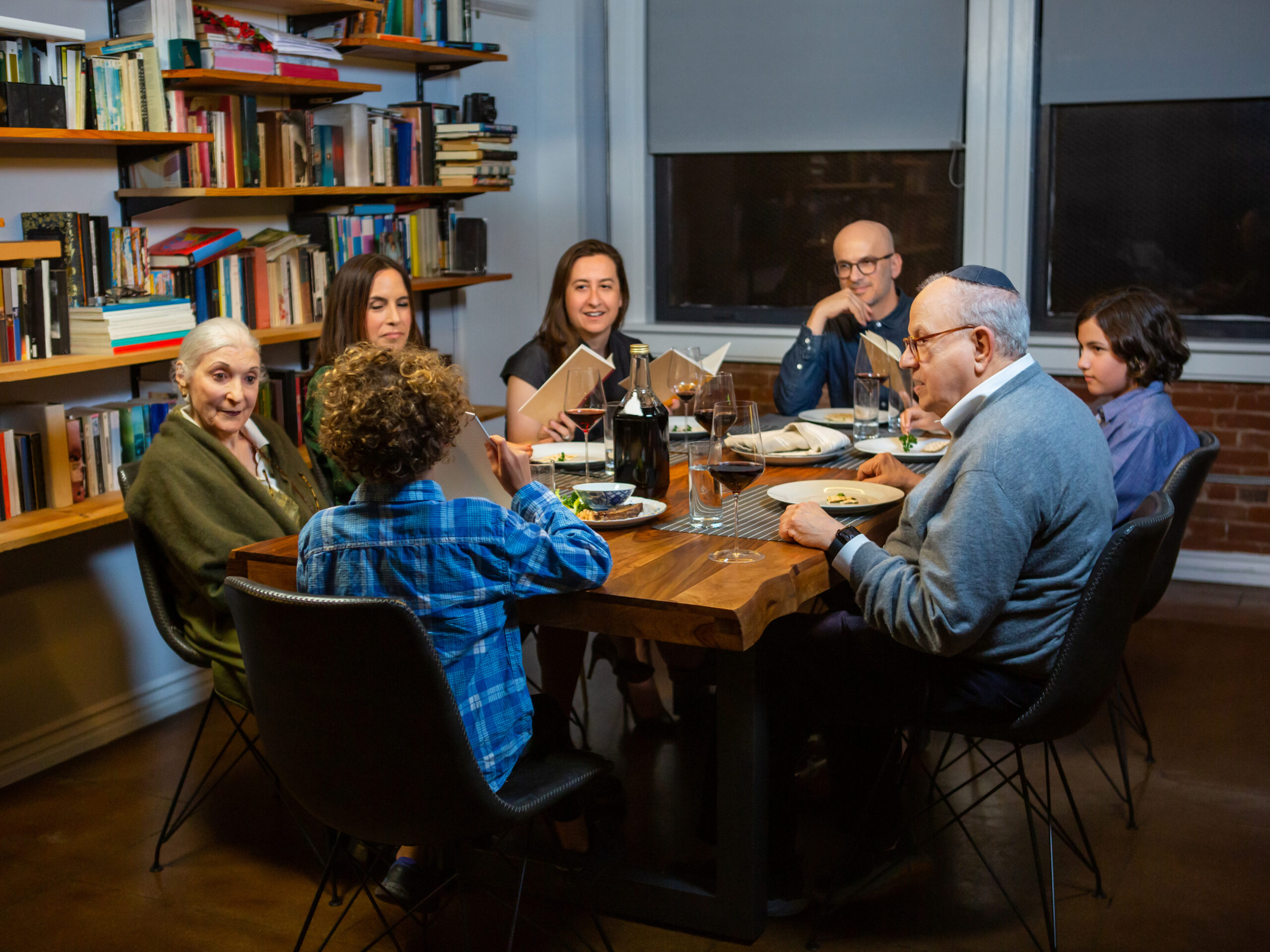
These gatherings weren’t fancy. They were real: challah and crafts, backyard sukkahs and break-fast bagels. What made them meaningful wasn’t the setup. It was the people around the table, and the joy of being together.
This kind of connection isn’t limited to holidays or host homes. It’s happening across our community through Federation events, local gatherings, and meaningful moments both big and small. If you’re looking for your next step, the Community Calendar.
And if you’re not yet receiving free Jewish children’s books from PJ Library each month, it’s the perfect time to sign up. Stories are just the beginning.
You don’t need a theme, a guest list, or a perfect table setting. Just start small. When you’re ready, your Jewish community will meet you where you are.