Bagels and Business with Randy Altschuler
Surveys released last week by the Jewish Federations of North America and Combined Jewish Philanthropies of Greater Boston are among the first to report Jewish views about Israel since early in the Gaza war. They are also among the first in a very long time that ask Jewish respondents whether they identify as Zionists, and what they mean by the term. The findings have important implications for how Jewish communal institutions relate to Israel and the rapidly expanding spectrum of opinion inside the American Jewish community.
Photo Credit: Alex Wong/Getty Images
Across our community, leaders are navigating real tensions: belonging and boundaries, safety and responsibility, clarity and pluralism. These aren’t abstract debates. They shape what Jewish life feels like in our synagogues, agencies, schools, and communal spaces every single day.
How leaders hold that complexity determines whether our community feels safe or splintered, principled or reactive, connected or alone.
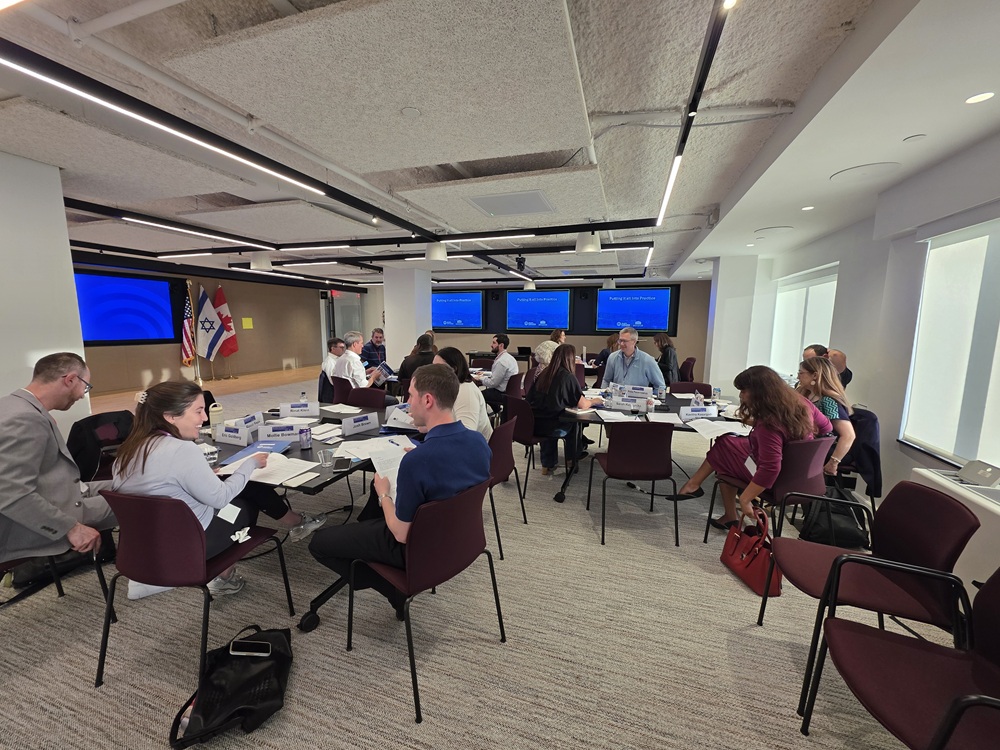
That’s why The Jewish Federation of Greater Washington continues to partner with the Shalom Hartman Institute as part of a sustained investment in Jewish leadership. Together, we equip leaders across our region with the shared language and frameworks needed to navigate complex communal challenges. Earlier this month, that partnership convened senior and emerging leaders for a candid conversation about what this moment requires of a vibrant Jewish community.
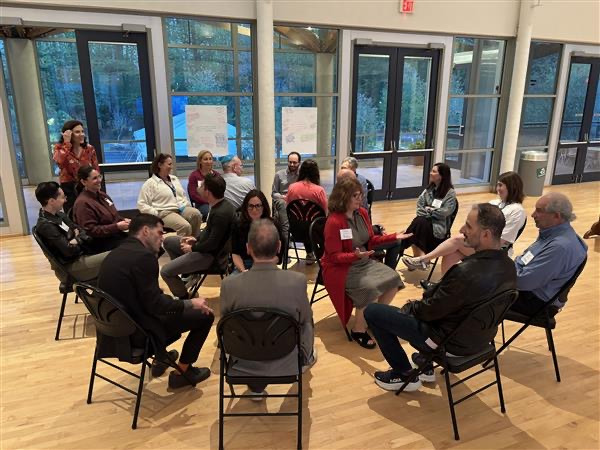
More than 60 leaders participated across the full spectrum of Jewish Greater Washington: congregational rabbis, synagogue presidents, agency executives, foundation trustees, long-time board members, and rising lay leaders. They represented institutions across denominations, missions, and generations—many of whom do not typically sit at the same tables.
Bringing this breadth of leadership into one room reflects Federation’s unique role and its investment in the relationships and common language leaders need to respond to difference with intention instead of reaction.
Our community includes many organizations, identities, ideologies, and expressions of Jewish belonging. Honoring that breadth and creating space where it can exist in conversation rather than collision is central to our mission as a community builder.
The goal was not uniformity, but shared understanding.
To anchor the conversation, we drew on the “Our Fragile Tents” framework developed and presented by Yehuda Kurtzer, President of the Shalom Hartman Institute. The framework offered language to help leaders name the fractures, fears, and ideological divides shaping Jewish life today, allowing the conversation to go deeper, faster.
Leaders began at tables, speaking openly about the tensions inside their own institutions. Several distinctions proved especially clarifying: the difference between communities of kinship and communities of consent; the ways participation, interest, and national identity shape expectations; and the recognition that not every community can or should operate by the same norms.
Leaders spoke candidly about what they are holding:
“Understanding the boundaries necessary in my community that may not be necessary in the larger Jewish community was eye-opening.”
“The varying definitions of community and the norms that guide them will directly shape how I lead.”
As leaders explored one another’s reflections, it became clear that no single institution is holding this moment alone.
No one left with every tension resolved. Agreement was never the objective. The goal was building the relationships and shared understanding that allow our community to move through strain without fracturing.
The conversation underscored how much this moment requires coordination and clarity across our community. No single synagogue, agency, or leadership body can bring this breadth of voices together across ideologies and generations.
By convening leaders in serious dialogue, Federation strengthens the relationships that help our community stay steady under pressure. Without shared language and cross-institutional relationships, leaders are left to navigate strain in isolation. Bringing institutions together ensures those tensions are held collectively rather than alone.
When leaders share common language and trust one another, institutions are better positioned to respond with clarity rather than escalation, with steadiness rather than isolation. The experience of Jewish life across our region—how safe it feels, how welcoming it feels, how principled it feels—is shaped by those choices.
A vibrant Jewish community depends on leaders who can hold complexity with clarity, speak honestly across difference, and remain committed to the whole, especially when it’s hard.
Strengthening that leadership capacity is central to Federation’s mission and essential to the long-term resilience of Jewish life in Greater Washington.
This convening was one step. Federation is now reviewing and synthesizing the reflections shared that evening to guide our next steps, so leaders across our community are better equipped for what this moment demands.
About the Partnership
For eight years, Federation’s partnership with the Shalom Hartman Institute has been rooted in a shared commitment to strengthening Jewish leadership and deepening relationships across our diverse community. Together, we have built a space for learning, reflection, and growth—a place where leaders wrestle with big questions, develop the clarity and courage needed to navigate complex times, and explore how to hold our community’s multitude of perspectives when the stakes feel high while communicating across differences in service of a stronger, more connected Greater Washington Jewish community.
Federation’s leadership programs help emerging and seasoned leaders alike grow their skills, deepen Jewish learning, and lead with purpose.
Earlier this month, Bret Stephens delivered the State of World Jewry address at 92NY. His remarks caught people’s attention. Stephens argued the Jewish community should shift energy and resources away from fighting antisemitism and instead double down on investing in Jewish education and engagement. As he put it, “Jew hatred is the product of a psychological reflex, and that kind of reflex can never be educated out of existence, even if, for a time, it may be sublimated or shamed into quiescence.”
I agree and disagree with his main points (and find fault with some of the additional opinions he presented). I agree with Stephens that now is a moment for Jewish revival, that helping more people explore and connect with Jewish ideas, practices, and peoplehood will be what shapes a vibrant Jewish future. At Federation, we are committed to working across our community to invest in and scale substantive, meaningful Jewish experiences—like summer camp, trips to Israel, learning and discussion opportunities, day school, and more—so that anyone who is interested has the chance to dig in and discover the joy of Jewish life.
But it would be irresponsible to ignore the work of countering antisemitism. We can and should be leaders in holding individuals and institutions to account and helping people understand antisemitism as a serious issue. Our work to build relationships, alliances, and understanding is not futile. If there are things we can do to mitigate hateful behavior, we should do them.
Admittedly, we may not be able to change the minds of the Carlsons and the Owenses of the world. But we can help shape programming and guidelines for schools, educate and engage leaders, work with teenagers before they go to college, and build bridges with other minority and interfaith communities, among other efforts. Not only does this work help address antisemitism, but it may also change the lived experiences of many in the Jewish community.
Stephens muses, “There is nothing Jews can do to cure the Jew haters of their hate. They can hire their own psychiatrists.” And he may be right. We are not responsible for people’s hateful and misguided beliefs. But perhaps I have a bit more faith than Stephens in our ability to multitask. I am confident we can build vibrant Jewish life while protecting it and being there for the students and teachers and everyday people who are coming face to face with antisemitism on a regular basis.
As Jews, we don’t ignore, we tackle. Today, that means being part of the sacred, collective efforts to stop hate before it starts while simultaneously strengthening Jewish identity, pride, and joy for the future.
Jewish Disability Awareness, Acceptance, and Inclusion Month (JDAIM) invites us each year to ask a hard but necessary question: who feels fully welcomed into Jewish communal life and who still encounters barriers, even when our intentions are good?
In recent years, our community has begun to confront an uncomfortable truth., While many Jewish organizations deeply value inclusion, good intentions alone are not enough to create access, especially for young adults with disabilities. Inclusion requires skills, systems, and sustained commitment.
That realization came into focus in 2023, when we partnered with Matan, a national leader in disability inclusion in Jewish life, to conduct a communitywide assessment. Matan works with Jewish organizations across North America to build the tools and confidence needed to create truly inclusive communities. One finding stood out clearly: Jewish professionals wanted to be inclusive of people with disabilities, particularly young adults, but many did not know how to translate that desire into practice.
That insight became a turning point.
In response, we launched the Lieberman Fellowship for Jewish Organizations Serving Young Adults, a yearlong cohort learning experience (2024–2025) led by Matan. The fellowship focused on moving organizations from intention to implementation, helping teams rethink policies, practices, and culture through an inclusion lens. At the conclusion of the learning year, participating organizations, along with one additional congregation, received grants to turn learning into action through concrete inclusion projects.
This JDAIM, we pause to take stock of progress at the projects’ midpoint. What we found was encouraging—not because the work was finished, but because it is becoming more thoughtful, more systematic, and more honest.
Across the region, organizations are shifting away from ad hoc accommodations toward intentional, systems-based approaches to access. Some are redesigning how people request accommodations or improving digital and physical accessibility. Others are investing in staff training, inclusive employment pathways, peer support, or relationship-centered spaces like Shabbat tables and social programming. Again and again, we are seeing that small but deliberate changes—clear communication, accessible tools, sensory supports—can dramatically expand participation and belonging.
That progress has not come without challenges. Many teams underestimated how long it would take to coordinate across departments and partners. Staff transitions and technology limitations slowed timelines. In some cases, organizations intentionally slowed decision-making to ensure solutions would be sustainable and meaningful rather than rushed. These challenges are real, but they also reflect a growing sophistication in how our community understands inclusion: not as a quick fix, but as long-term work that must be built to last.
Each organization is approaching inclusion differently, shaped by its mission, audience, and capacity. Together, these efforts reflect a shared shift toward more intentional and sustainable access.
Perhaps the most important lesson emerging from this work: inclusion is grounded in relationships, strengthened through training, and sustained by systems, not by individuals alone. When access is embedded into how organizations operate, it becomes part of communal life.
This JDAIM, we are not just raising awareness. We are witnessing growth—imperfect, iterative, and deeply committed. Our community is learning what it truly means to create Jewish spaces where young adults with disabilities are not merely accommodated, but genuinely welcomed, supported, and able to belong.
| Register |
| Register |
This past week I had the privilege of joining an informal group of Jewish foundation and Federation leaders to discuss issues facing Jewish life. This year especially, I appreciated the intentional time, set aside from my usual schedule, to dive into some deep discussions. The seventy-degree weather didn’t hurt either.
The tenor of our time together included a clear focus on the future. Everyone agreed that fighting antisemitism remains an urgent and essential priority for which we need to have a more integrated and effective strategy. At the same time, people were most eager to talk about the things we could build together. How to strengthen Jewish engagement, communal trust, bridges to other communities, our vision for a vibrant, pluralistic Jewish future, and so on.
Coursing through the week was the idea that now is a time to go all in. We are living in a moment that calls on us to grapple with the most critical issues facing the Jewish community. This is not a time for avoidance or incrementalism. We should not—and must not—shy away from what needs to be done.
And we can do it! Because the other consistent takeaway was that we collectively have the capacity to meet this moment so long as we work together. No single individual, organization, or foundation can achieve their goals independently but combined, we have everything we need to realize our shared ambitions. The scale and complexity of both the challenges and the opportunities we face demand collaboration, humility, and shared responsibility.
In the end, I left for the airport feeling hopeful. There are extraordinary people across the country doing extraordinary work on behalf of the Jewish people, thoughtfully, courageously, and with deep care for our community. I want to hold onto this thought for 2026 and, like the California sun, soak up all its benefits.
|