From Intention to Action: What JDAIM Is Teaching Our Community About Inclusion
Jewish Disability Awareness, Acceptance, and Inclusion Month (JDAIM) invites us each year to ask a hard but necessary question: who feels fully welcomed into Jewish communal life and who still encounters barriers, even when our intentions are good?
When values outpace systems
In recent years, our community has begun to confront an uncomfortable truth., While many Jewish organizations deeply value inclusion, good intentions alone are not enough to create access, especially for young adults with disabilities. Inclusion requires skills, systems, and sustained commitment.
Learning what inclusion requires
That realization came into focus in 2023, when we partnered with Matan, a national leader in disability inclusion in Jewish life, to conduct a communitywide assessment. Matan works with Jewish organizations across North America to build the tools and confidence needed to create truly inclusive communities. One finding stood out clearly: Jewish professionals wanted to be inclusive of people with disabilities, particularly young adults, but many did not know how to translate that desire into practice.
That insight became a turning point.
Turning learning into action
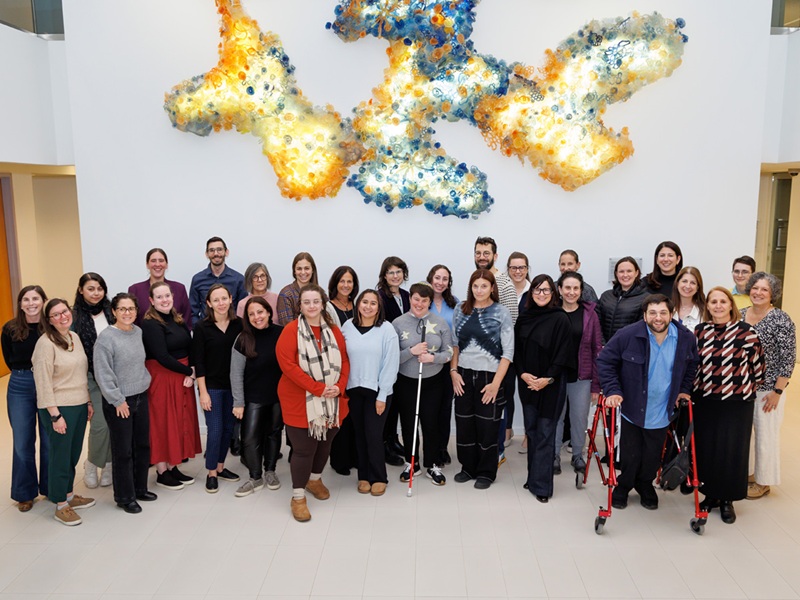
In response, we launched the Lieberman Fellowship for Jewish Organizations Serving Young Adults, a yearlong cohort learning experience (2024–2025) led by Matan. The fellowship focused on moving organizations from intention to implementation, helping teams rethink policies, practices, and culture through an inclusion lens. At the conclusion of the learning year, participating organizations, along with one additional congregation, received grants to turn learning into action through concrete inclusion projects.
This JDAIM, we pause to take stock of progress at the projects’ midpoint. What we found was encouraging—not because the work was finished, but because it is becoming more thoughtful, more systematic, and more honest.
What’s changing across our community
Across the region, organizations are shifting away from ad hoc accommodations toward intentional, systems-based approaches to access. Some are redesigning how people request accommodations or improving digital and physical accessibility. Others are investing in staff training, inclusive employment pathways, peer support, or relationship-centered spaces like Shabbat tables and social programming. Again and again, we are seeing that small but deliberate changes—clear communication, accessible tools, sensory supports—can dramatically expand participation and belonging.
That progress has not come without challenges. Many teams underestimated how long it would take to coordinate across departments and partners. Staff transitions and technology limitations slowed timelines. In some cases, organizations intentionally slowed decision-making to ensure solutions would be sustainable and meaningful rather than rushed. These challenges are real, but they also reflect a growing sophistication in how our community understands inclusion: not as a quick fix, but as long-term work that must be built to last.
Inclusion, in action
Each organization is approaching inclusion differently, shaped by its mission, audience, and capacity. Together, these efforts reflect a shared shift toward more intentional and sustainable access.
Inclusive employment and workforce pathways
- Adas Israel is piloting a supported employment program for young adults with intellectual and developmental disabilities, envisioning a multi-year pathway to meaningful, paid work and vocational growth.
Accessible spaces, programs, and experiences
- Bender JCC is investing in accessible fitness equipment and assistive listening devices, alongside hosting sensory-friendly cultural programming.
- Edlavitch DCJCC repaired hazardous entryways and launched a visibility campaign highlighting accessibility across programs.
Digital communications access
- GatherDC transformed its community calendar to include accessibility information, mobile usability, and screen-reader tools, changing how thousands of young adults find Jewish experiences.
Peer support, community design, and belonging
- B’nai Israel Congregation is pairing a young adult inclusion peer program with accessible communication training for staff and lay leaders.
- OneTable supported hosts creating intentionally inclusive Shabbat tables, including spaces centered for autistic and Deaf/ASL communities.
Data-informed systems and long-term engagement
- Pozez JCC is building data-informed systems to track and strengthen engagement of neurodiverse young adults over time.
Training, capacity-building, and organizational practice
- Mem Global distributed social inclusion kits, launched accessibility microgrants, and is preparing to hire a Camper Care Director to support emotional and behavioral needs at immersive experiences.
- Sixth & I is preparing comprehensive social inclusion trainings for staff and volunteers serving young adults in less-structured Jewish spaces.
- Temple Rodef Shalom standardized its accommodation request process, shifting from informal responses to clear, transparent, and equitable access systems.
The lesson we’re carrying forward
Perhaps the most important lesson emerging from this work: inclusion is grounded in relationships, strengthened through training, and sustained by systems, not by individuals alone. When access is embedded into how organizations operate, it becomes part of communal life.
Beyond JDAIM
This JDAIM, we are not just raising awareness. We are witnessing growth—imperfect, iterative, and deeply committed. Our community is learning what it truly means to create Jewish spaces where young adults with disabilities are not merely accommodated, but genuinely welcomed, supported, and able to belong.