From Fragmentation to Framework: A Regional Leadership Conversation
How We Hold Complexity Shapes What Community Feels Like
Across our community, leaders are navigating real tensions: belonging and boundaries, safety and responsibility, clarity and pluralism. These aren’t abstract debates. They shape what Jewish life feels like in our synagogues, agencies, schools, and communal spaces every single day.
How leaders hold that complexity determines whether our community feels safe or splintered, principled or reactive, connected or alone.
That’s why The Jewish Federation of Greater Washington continues to partner with the Shalom Hartman Institute as part of a sustained investment in Jewish leadership. Together, we equip leaders across our region with the shared language and frameworks needed to navigate complex communal challenges. Earlier this month, that partnership convened senior and emerging leaders for a candid conversation about what this moment requires of a vibrant Jewish community.
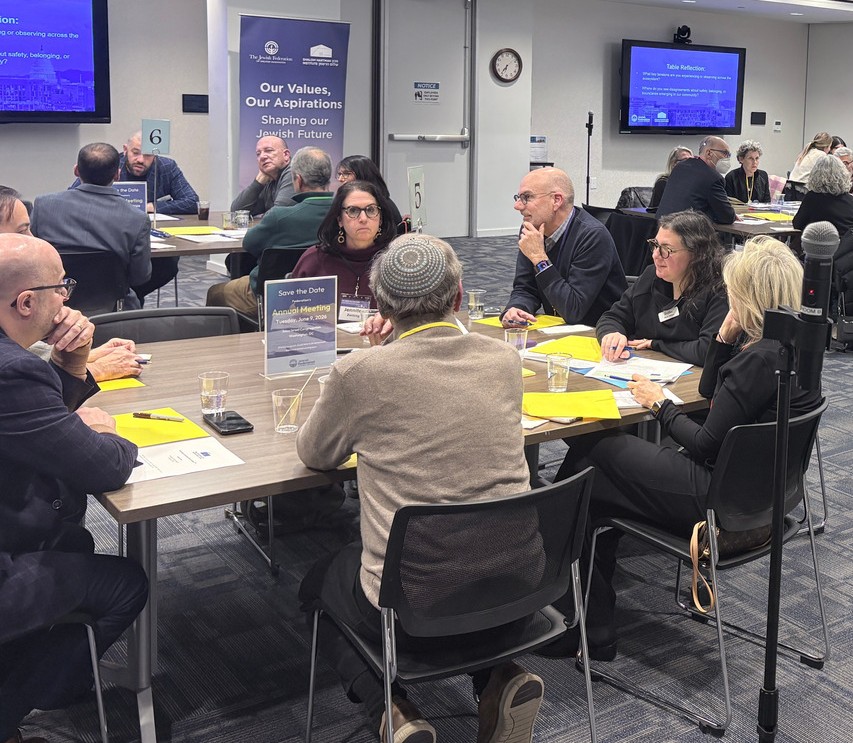
More than 60 leaders participated across the full spectrum of Jewish Greater Washington: congregational rabbis, synagogue presidents, agency executives, foundation trustees, long-time board members, and rising lay leaders. They represented institutions across denominations, missions, and generations—many of whom do not typically sit at the same tables.
Bringing this breadth of leadership into one room reflects Federation’s unique role and its investment in the relationships and common language leaders need to respond to difference with intention instead of reaction.
Shared Language in a Strained Moment
Our community includes many organizations, identities, ideologies, and expressions of Jewish belonging. Honoring that breadth and creating space where it can exist in conversation rather than collision is central to our mission as a community builder.
The goal was not uniformity, but shared understanding.
To anchor the conversation, we drew on the “Our Fragile Tents” framework developed and presented by Yehuda Kurtzer, President of the Shalom Hartman Institute. The framework offered language to help leaders name the fractures, fears, and ideological divides shaping Jewish life today, allowing the conversation to go deeper, faster.
Leaders began at tables, speaking openly about the tensions inside their own institutions. Several distinctions proved especially clarifying: the difference between communities of kinship and communities of consent; the ways participation, interest, and national identity shape expectations; and the recognition that not every community can or should operate by the same norms.
Leaders spoke candidly about what they are holding:
“Understanding the boundaries necessary in my community that may not be necessary in the larger Jewish community was eye-opening.”
“The varying definitions of community and the norms that guide them will directly shape how I lead.”
As leaders explored one another’s reflections, it became clear that no single institution is holding this moment alone.
No one left with every tension resolved. Agreement was never the objective. The goal was building the relationships and shared understanding that allow our community to move through strain without fracturing.
Strengthening the Ecosystem
The conversation underscored how much this moment requires coordination and clarity across our community. No single synagogue, agency, or leadership body can bring this breadth of voices together across ideologies and generations.
By convening leaders in serious dialogue, Federation strengthens the relationships that help our community stay steady under pressure. Without shared language and cross-institutional relationships, leaders are left to navigate strain in isolation. Bringing institutions together ensures those tensions are held collectively rather than alone.
When leaders share common language and trust one another, institutions are better positioned to respond with clarity rather than escalation, with steadiness rather than isolation. The experience of Jewish life across our region—how safe it feels, how welcoming it feels, how principled it feels—is shaped by those choices.
A vibrant Jewish community depends on leaders who can hold complexity with clarity, speak honestly across difference, and remain committed to the whole, especially when it’s hard.
Strengthening that leadership capacity is central to Federation’s mission and essential to the long-term resilience of Jewish life in Greater Washington.
This convening was one step. Federation is now reviewing and synthesizing the reflections shared that evening to guide our next steps, so leaders across our community are better equipped for what this moment demands.
About the Partnership
For eight years, Federation’s partnership with the Shalom Hartman Institute has been rooted in a shared commitment to strengthening Jewish leadership and deepening relationships across our diverse community. Together, we have built a space for learning, reflection, and growth—a place where leaders wrestle with big questions, develop the clarity and courage needed to navigate complex times, and explore how to hold our community’s multitude of perspectives when the stakes feel high while communicating across differences in service of a stronger, more connected Greater Washington Jewish community.
Federation’s leadership programs help emerging and seasoned leaders alike grow their skills, deepen Jewish learning, and lead with purpose.